
When the Internet Isn't an Option, Learning Shouldn't Stop Either

Updated: Aug 21

In Kenya's frontier counties, Grade 6 students are learning spreadsheet formulas on hardware that has never touched the internet — here's why that matters.
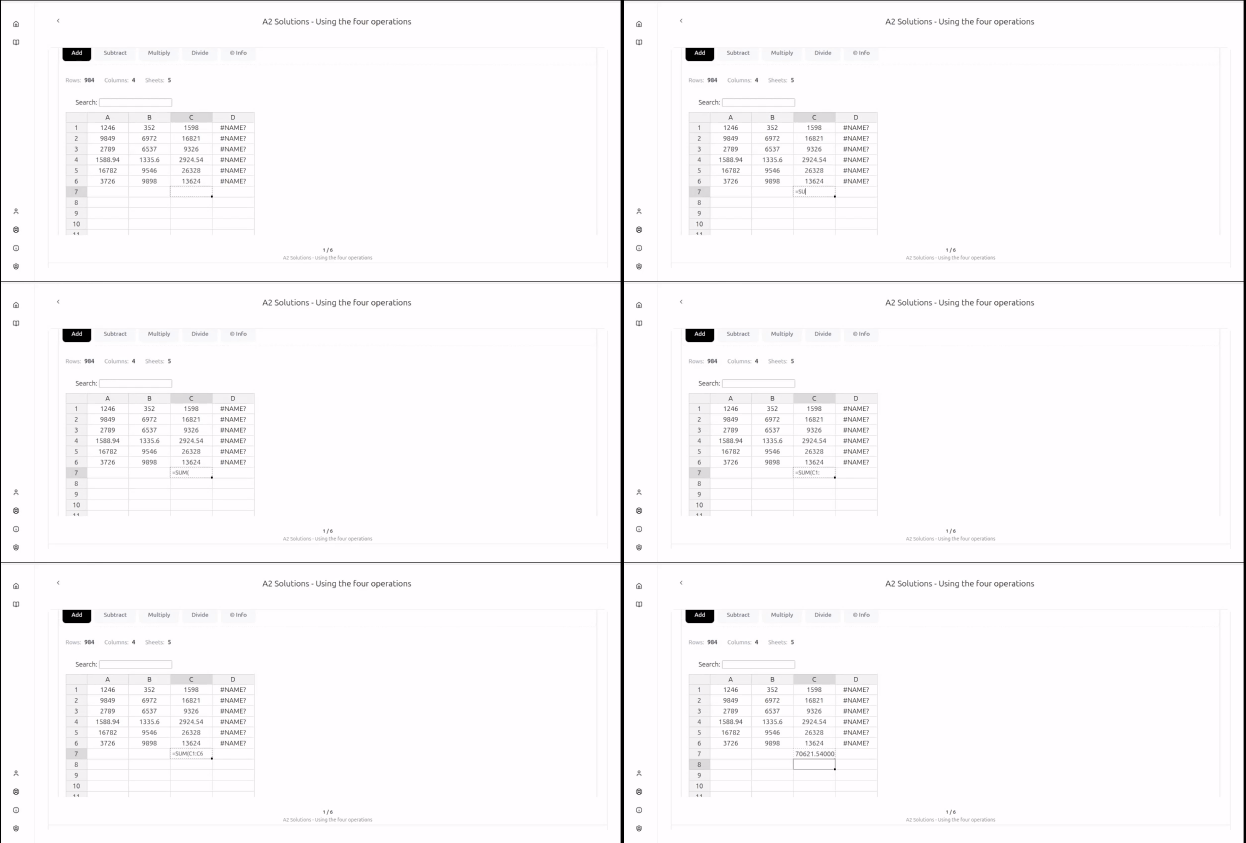
There is a moment that stays with you after a school visit in a frontier county. A student, perhaps eleven or twelve years old, leans toward a screen and types a formula into a spreadsheet cell. She watches it calculate. Something clicks. She types another one.
There is no internet connection in that room. There is no IT administrator on call. And for many of the teachers in that room, this was their first time working with spreadsheet formulas too. What there is, is a lesson running exactly as designed — because the technology was built for that room, not for an alternate imagined environment with reliable broadband.
This is what drew Ontum Education into partnership with the Raspberry Pi Foundation and Kenya's Frontier Counties Development Council. Not the technology itself, but what the technology makes possible in places where connectivity has long been treated as a prerequisite for digital learning. Across 30 schools in 12 counties in Kenya, Grade 6 learners are building digital literacy skills — spreadsheets, formulas, foundational computer use — on a system that functions smoothly without the need of the internet. Because in these communities, it often is not an affordance to them.
The gap that Kul is designed to close is not primarily a hardware gap or a software gap. It is an assumptions gap. Most educational technology is built for contexts where connectivity is reliable enough to treat as a given. When that assumption fails — and in Kenya's frontier counties, in rural Uganda, in underserved schools across India, it fails routinely — the technology fails with it. Students don't fall behind because they lack ability or motivation. They fall behind because the tools weren't designed for where they actually live. And teachers can't teach what they've never had the chance to learn themselves.
Ontum's approach with Kul starts from the other end. Offline-first is not a feature added to make the product work in difficult conditions. It is the design constraint that shapes every decision: how content is stored and delivered, how the device behaves when something goes wrong, how a teacher can keep a lesson running without calling for help that may be hours away. If a fix requires a technician visit, the engineering team treats that as a failure to get right in the next iteration.
Students don't fall behind because they lack ability or motivation. They fall behind because the tools weren't designed for where they actually live. And teachers can't teach what they've never had the chance to learn themselves.
What this means in practice is that the same lesson a student in a well-resourced urban school receives can reach a student in a frontier county classroom — not a degraded version of it, not a workaround, but the same digital literacy curriculum, running on local WiFi with no internet backhaul required. The Raspberry Pi Foundation partnership brings curriculum quality and on-the-ground reach. FCDC brings community knowledge and school-level relationships. Kul provides the delivery layer that makes any of it possible without waiting for infrastructure that may not arrive for years.

The students learning spreadsheets in those classrooms are not a pilot population or a proof of concept. Neither are the teachers discovering these tools alongside them. They are the reason the work exists. Digital literacy is increasingly the entry point to economic participation — to the kinds of jobs, further education, and self-sufficiency that families in frontier counties are working toward for their children. Every classroom that can't run a digital lesson because the connection dropped is a classroom where that future gets harder to reach.
Kul provides the delivery layer that makes any of it possible without waiting for infrastructure that may not arrive for years.
We think education delivery should not wait for infrastructure. That is not an idealistic statement. It is a design requirement — one that shapes how we build, how we test in the field, and what we consider a success. A student completing a spreadsheet lesson offline, in a school that has never had reliable internet, learning alongside a teacher who is also encountering these tools for the first time — that is the measure we work toward.
There are more schools across Kenya, Uganda, and India where this work continues. The formula is not complicated: build for the room as it actually is, not the room you wish it were, and learning follows.


Comments